Summary
Debate has emerged over the African Union's (AU) definition of the African diaspora, especially regarding whether Africans living in other African countries should be included. This brief contends that the main challenge is not the AU definition itself, but the lack of clear differentiation and effective institutional implementation. Distinguishing between the African diaspora and intra-African migrants can strengthen both diaspora partnerships and regional integration.- The current AU’s definition of the African diaspora should be retained, while complementary policy categories are developed for intra-African migrants on the continent.
- African diaspora and intra-African migrants make distinct but equally valuable contributions to Africa’s development at all levels.
- Africa’s priority should shift from debating definitions to improving policy implementation that addresses real gaps in migration and diaspora partnerships.
Introduction
Africa's population and the number of African migrants are both rising[1]. Migrants play a central role in Africa's development[2], but they are not a homogeneous group. Governments and regional institutions across the continent recognise that people of African origin living outside their communities, countries, and regions contribute not only through remittances but also by driving investment, knowledge transfer, diplomacy, intercontinental connections, and Africa's integration agenda. Effective engagement of Africans outside their communities, countries, regions, and the continent requires clear definitions. For example, if the term 'African diaspora' is used too broadly, it loses policy relevance; if too narrowly, it may exclude groups with strong ties to Africa. It is not only who belongs to the diaspora or migration categories, but also how to understand different forms of African ancestry, mobility, citizenship, belonging, and identity for policy purposes. All Africans on the move matter, but they should not be grouped into a single policy category. Recently, the African Union's (AU) definition of the African diaspora has been debated, especially regarding whether Africans living in other African countries should be included. This brief contends that the main challenge is not the AU definition itself, but the lack of differentiation and effective institutional implementation of migration and diaspora policies.The AU Definition Critique
The AU[3] defines the African Diaspora as "people of African origin living outside the continent, irrespective of their citizenship and nationality and who are willing to contribute to the development of the continent and the building of the African Union." Some stakeholders believe this definition lacks operational precision[4]. This concern was raised at the African stakeholders' forum on diaspora in Addis Ababa in April 2026, themed "Harnessing Diaspora Potential for Continental Development." Participants highlighted gaps in implementing diaspora cooperation and questioned whether the AU definition reflects the realities of African mobility and contributions. A key issue is that Africans migrating within the continent also remit, invest, and transfer knowledge to their countries of origin. According to the World Bank[5], Sub-Saharan countries received US$55.8 billion in personal remittances in 2024. World Bank estimates that these flows originate from both within Sub-Saharan Africa and from outside the region[6]. Based on these arguments, some stakeholders called for a review of the AU's definition, viewing it as narrow and operationally problematic.Intra-African Migrants and the African Diaspora
Imagine a family compound with 54 rooms, each representing an AU member state. Kofi and Hawa are siblings living there. Kofi moves between rooms within the compound, while Hawa leaves to live in a neighbouring compound. Both may continue to support their family, maintain emotional ties, and contribute resources. However, their locations place them in different policy categories. Kofi represents an intra-African migrant, living in another African country. Hawa represents the African diaspora as defined by the AU. Both groups are important for Africa's development and may remit, invest, transfer skills, and maintain ties with their countries of origin. However, their shared contributions do not mean they belong in the same policy category. The key policy question is whether the same definitions and instruments should apply to both. Many AU member states define diaspora at the national level, not continentally as the AU does. For example, Kenyan citizens in Angola are considered part of the Kenyan diaspora in alignment with Kenya's constitution – as Kenyan citizens living abroad[7]; and not from the AU's continental perspective. While migration underpins many diasporic formations, not all migration results in the same policy category. For continental purposes, the African diaspora should refer to persons of African origin residing outside Africa. The AU and its member states should also recognise intra-African migrants through migration, mobility, citizenship, labour, and integration frameworks.They face documentation challenges, labour-market exclusion, xenophobia, limited access to services, and weak protection from both host and origin states. These issues are best addressed through migration governance, regional integration, labour mobility, citizenship rights, social protection, and consular engagement, rather than by expanding the AU definition of African diaspora.Intra-African migrants need focused policy attention.
A Proposed Policy Taxonomy
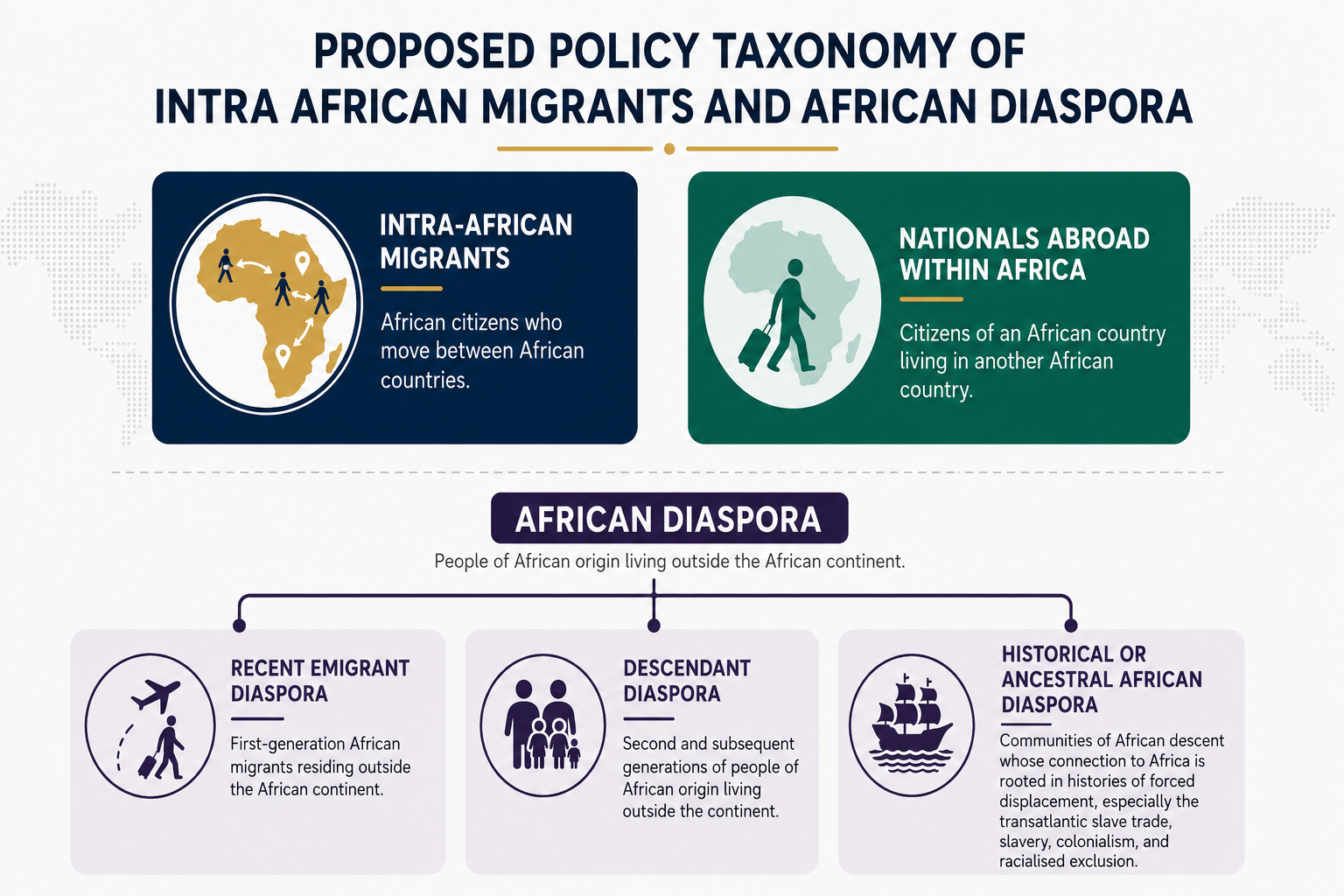
Statehood and sovereignty often lead AU member states to argue that their nationals elsewhere in Africa should be considered diaspora. While member states have a duty to engage all citizens abroad, treating all citizens abroad as a single group is overly simplistic and problematic. This approach overlooks shared and distinct experiences, ancestral ties, and solidarity, and undermines the AU's integration vision. In policy discussions, differentiating AU member state citizens residing in Africa from the diaspora is essential for operationalising definitions of the African diaspora and African migrants. To avoid confusion, member state actors, civil society organisations, and international development agencies should distinguish between categories of African mobility and belonging. Stakeholders often ask, "How should we define and engage them effectively?" The following taxonomy[8] may be useful for policy purposes:Intra-African Migrants
African nationals residing (immigrants) in an AU member state[9]. For example, Nigerians in Ethiopia, Kenyans in Tanzania, or Ghanaians in South Africa.Nationals Abroad within Africa
An AU member state national (emigrant) who resides in another African country. This category may be especially useful for national governments seeking to engage their citizens elsewhere on the continent.The African Diaspora
For AU-level purposes, this category should refer broadly to persons of African origin residing outside the continent who maintain an interest in contributing to Africa's development, integration, representation, and global positioning. This category can, however, be operationalised when further distinguished:- Emigrant Diaspora: First-generation African migrants residing outside the African continent. These individuals usually retain direct citizenship, family ties, economic ties, and political ties to their countries of origin.
- Descendant Diaspora: Second- and subsequent-generation people of African origin living outside the continent. Their ties to Africa may be familial, cultural, historical, symbolic, political, or economic.
- Historical or Ancestral African Diaspora: Communities of African descent whose connection to Africa is rooted in histories of forced displacement, especially the transatlantic slave trade, slavery, colonialism, and racialised exclusion[10].
Focusing on the Real Implementation Gaps
The main challenge for intra-African migrants and diaspora cooperation is not just the AU definition. Many African countries and institutions still lack the administrative systems, data infrastructure, policy instruments, and trust-based partnerships needed to engage different categories of migrants and diaspora communities. First, many countries lack reliable data on citizens abroad, diaspora communities, and nationals residing elsewhere in Africa. Without proper mapping, governments cannot design effective policies for investment, skills transfer, belonging, consular services, voting rights, cultural exchange, identity, or social protection. Second, diaspora and migrant cooperation is often fragmented across ministries, agencies, embassies, investment authorities, and ad hoc initiatives, weakening coordination and causing duplication. Third, trust deficits remain a major obstacle. Many diaspora communities and migrants are willing to contribute but are discouraged by corruption, bureaucratic delays, lack of transparency, weak dispute-resolution mechanisms, and limited confidence in public institutions. Fourth, citizenship and rights regimes remain uneven across the continent. Dual citizenship, voting rights from abroad, property rights, documentation, labour mobility, and access to services vary significantly between countries. Fifth, African governments often view diaspora communities primarily as sources of remittances, without investing enough in long-term partnership, representation, co-creation, and mutual accountability. Finally, intra-African migrants are often overlooked in diaspora debates, despite being central to the African Continental Free Trade Area, regional integration, labour mobility, and people-to-people cooperation. Their exclusion from diaspora policy should not result in policy neglect. Instead, they require dedicated frameworks suited to their location and legal status within Africa.Migration and Diaspora Policy Clarity
The debate over the African diaspora should not be reduced to inclusion versus exclusion. Both Africans who move within the continent and those of African origin living outside Africa are important to the continent's future. The policy challenge is to recognise their contributions without merging them into a single, imprecise category. At the AU level, the African diaspora should continue to be defined as persons of African origin residing outside the continent. Intra-African migrants should also be recognised through a distinct, equally important policy framework linked to migration governance, regional integration, labour mobility, citizenship rights, and social protection.Clear migration and diaspora policy categories enable African institutions to design appropriate policies, collect relevant data, build trust, and engage diverse communities based on their specific locations, histories, rights, and capacities. Africa's migration and diaspora integration agendas should be treated as complementary, not competing, priorities. Clear distinctions between the African diaspora and intra-African migrants can strengthen both. Research and targeted interventions can harness their developmental contributions and address their challenges, which is crucial for the AU and its member states.Clarity does not mean exclusion. In fact, clearer categories enable more effective inclusion.
Policy Recommendations
The AU- maintain the current continental definition of the African diaspora while developing complementary terminology for intra-African migrants and nationals abroad within Africa;
- develop a continental policy taxonomy that member states can adapt to reduce confusion among diaspora cooperation, migration governance approaches, labour mobility arrangements, and regional integration;
- support the creation of common data standards for mapping the African diaspora and intra-African migrants, while ensuring data protection, privacy, and ethical use;
- institutionalise regular continental dialogue involving diaspora organisations, migrant associations, member states, regional communities, civil society, private-sector actors, women, youth, and inter-generational communities.
- develop differentiated policies for citizens abroad within Africa and citizens or descendants outside the continent. These groups may overlap and converge in their contributions and investments, but they face different legal, political, and institutional realities;
- improve diaspora and migrant mapping through research, embassies and consulates, digital platforms, civil registration systems, and partnerships with community organisations;
- strengthen trust by reducing bureaucratic barriers, improving transparency, creating credible dispute-resolution mechanisms, and co-creating policies with diaspora and migrant groups;
- share experiences and learn from each other's successes on mapping, engagements, and migration and diaspora governance;
- review citizenship, voting, documentation, investment, and property frameworks to ensure that citizens abroad and diaspora communities can contribute without unnecessary administrative obstacles.
- address the specific needs of intra-African migrants through labour mobility frameworks, mutual recognition of skills, social protection portability, migrant rights, and anti-xenophobia measures;
- coordinate with the AU and member states to ensure that intra-African migration is treated as a central component of African integration, not as an afterthought in diaspora policy.
- support research, data systems, digital infrastructure, and institutional capacity for diaspora and migrant cooperation;
- avoid imposing externally designed cooperation models but instead support African-led frameworks that move away from colonial continuities;
- Multi-lateral African institutions such as the African Development Bank and the African Investment Bank should be positioned to support investment facilitation, skills-transfer initiatives, diaspora bonds, innovation networks, and platforms for intra-African and African diaspora women and youth.
- Engage in policy design, implementation, monitoring, and accountability processes. Such participation is important for building trust, identifying community needs, mobilising expertise, and ensuring that policies reflect lived realities;
- strengthen coordination among groups and organisations to avoid duplication, elite capture, exclusion, and the neglect of smaller or less visible communities;
- Build leadership capacities in statesmanship and diplomacy within migrant and diaspora communities to understand contextual issues in both host and home countries. This enables effective and cordial engagement with key stakeholders, rather than becoming political wings or policy afterthoughts.
- Avoid the use of imposed labels, definitions and taxonomies that promote anti-African integration and sentiments;
- Be interested in research that highlights the separate roles that intra-African migration and African diaspora play in Africa's development;
- Strengthen research on continental migration, while avoiding the use of terminologies, labels and frameworks that promote colonial continuities in the field of African migration and diaspora.